TreadPilot connects to FitShow-protocol treadmills over Bluetooth on iPhone or iPad and takes the wheel: live numbers, interval programs that drive the belt for you by time, distance or heart rate, Apple Watch or chest-strap heart rate, and completed runs that can be saved to Apple Health.
No TreadPilot account needed. Just your iPhone or iPad and the machine in front of you.
Scan for nearby treadmills over Bluetooth, then select yours to connect.
Speed, incline, distance, calories, steps and elevation, live every second.
Intervals that drive the belt for you by time, distance or heart rate — warm up, push, recover, cool down.
Make room for your goal.
Let the workout guide the treadmill.
Understand the run afterwards.
Your goal, your available days, your starting point. A clear mix of easy runs, long runs and quality work, with room to build.
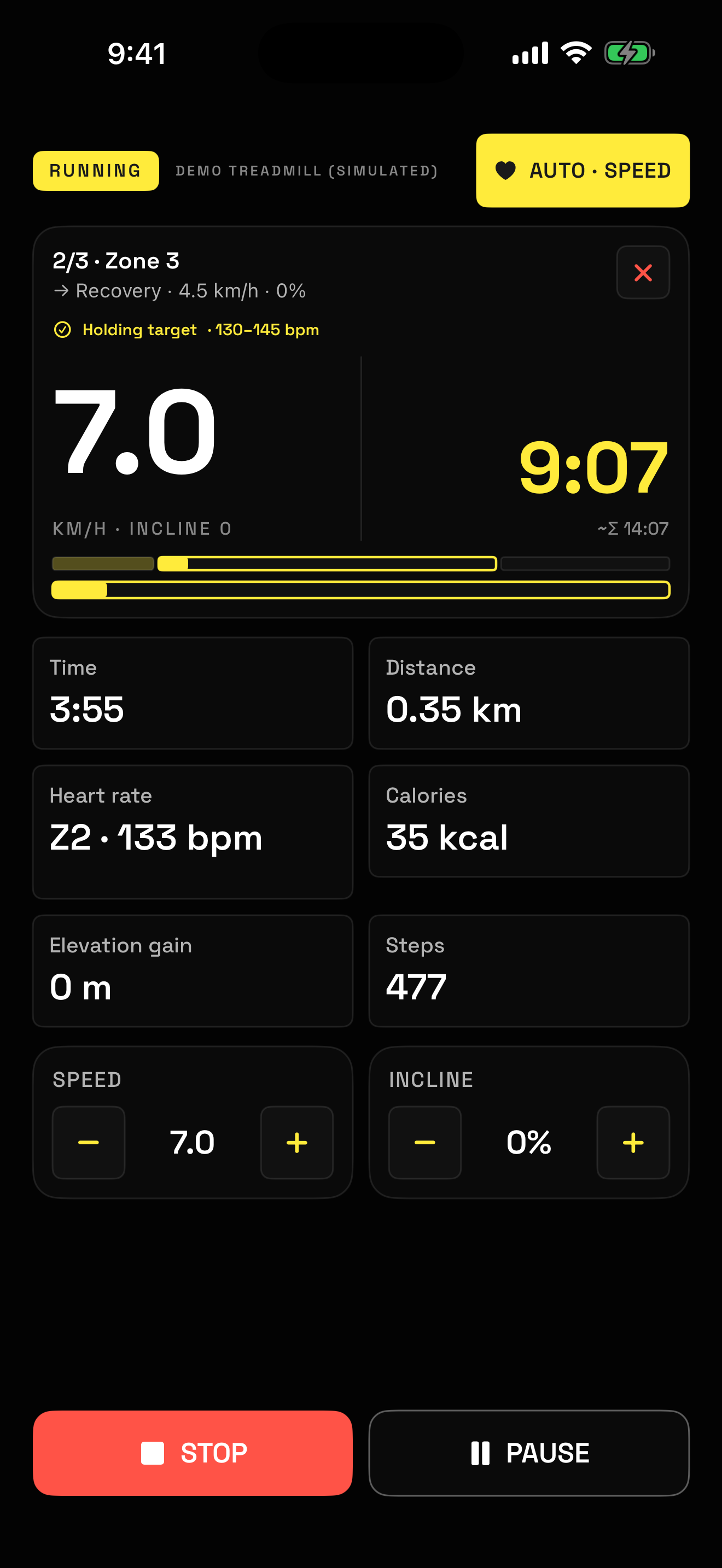
See the current block, your pace and your pulse at a glance. The program handles speed and incline on a compatible treadmill.
Go beyond a finish time. Review your pace and heart rate, add how the run felt, and follow the evidence behind your goal.
Explore at your pace. Select a chapter or enlarge a screen.
Plan and Review use real app components with sample training data. Run shows the app in Demo Mode on a simulated treadmill.
Elevation gain from speed and incline. Heart rate from your Apple Watch or a standard Bluetooth sensor. Calories from your real body data, not a generic guess. Every session charted and kept — with optional saving to Apple Health where the rest of your training lives.

TreadPilot starts and drives a real treadmill belt. It never starts without your explicit confirmation, and programmed starts always run a countdown you can cancel. Stand on the side rails, not on the belt, and clip on the safety key. If the Bluetooth link drops, the belt may keep running at the last set speed — your treadmill's own stop button and safety key remain your primary protection.
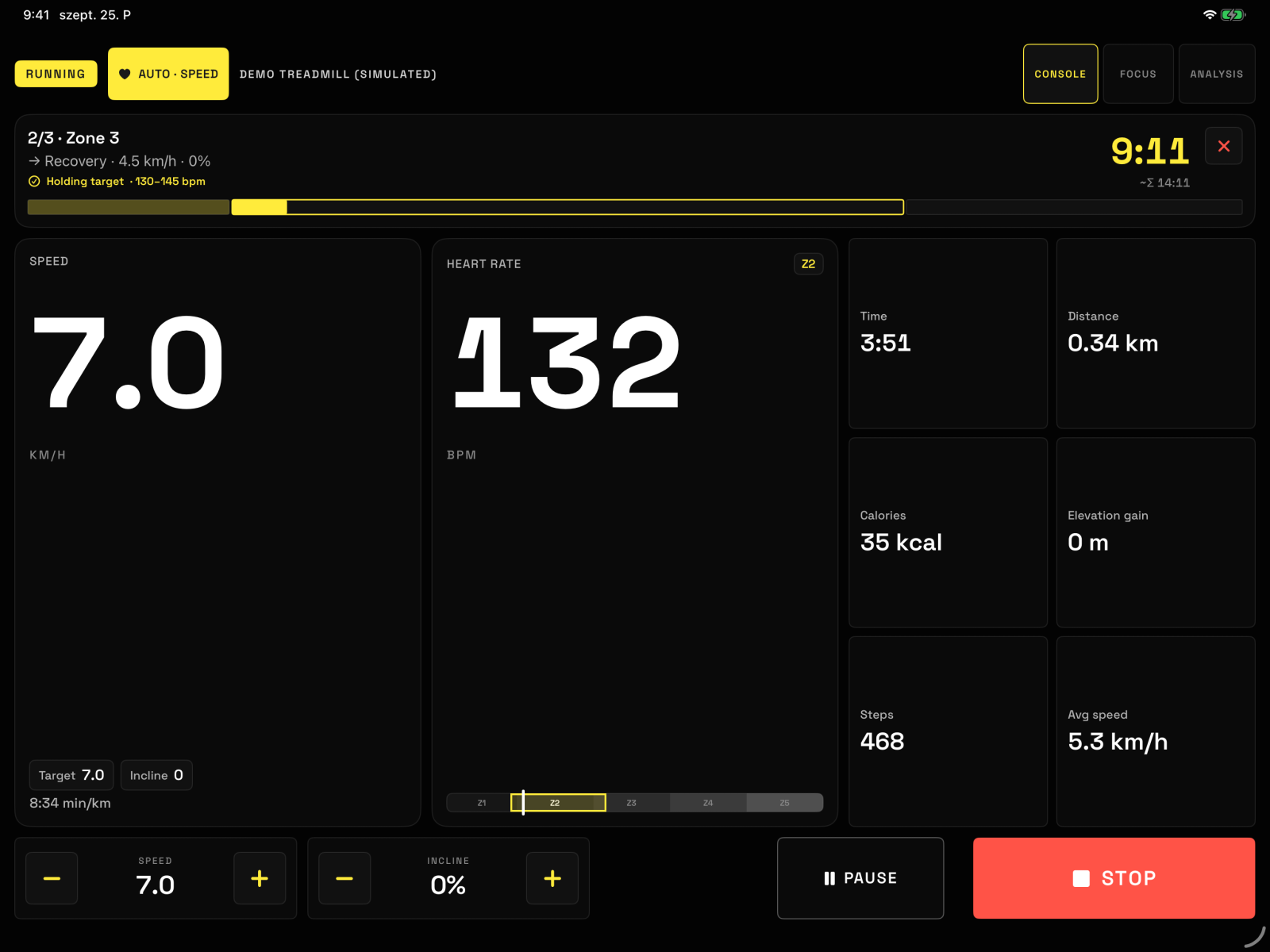
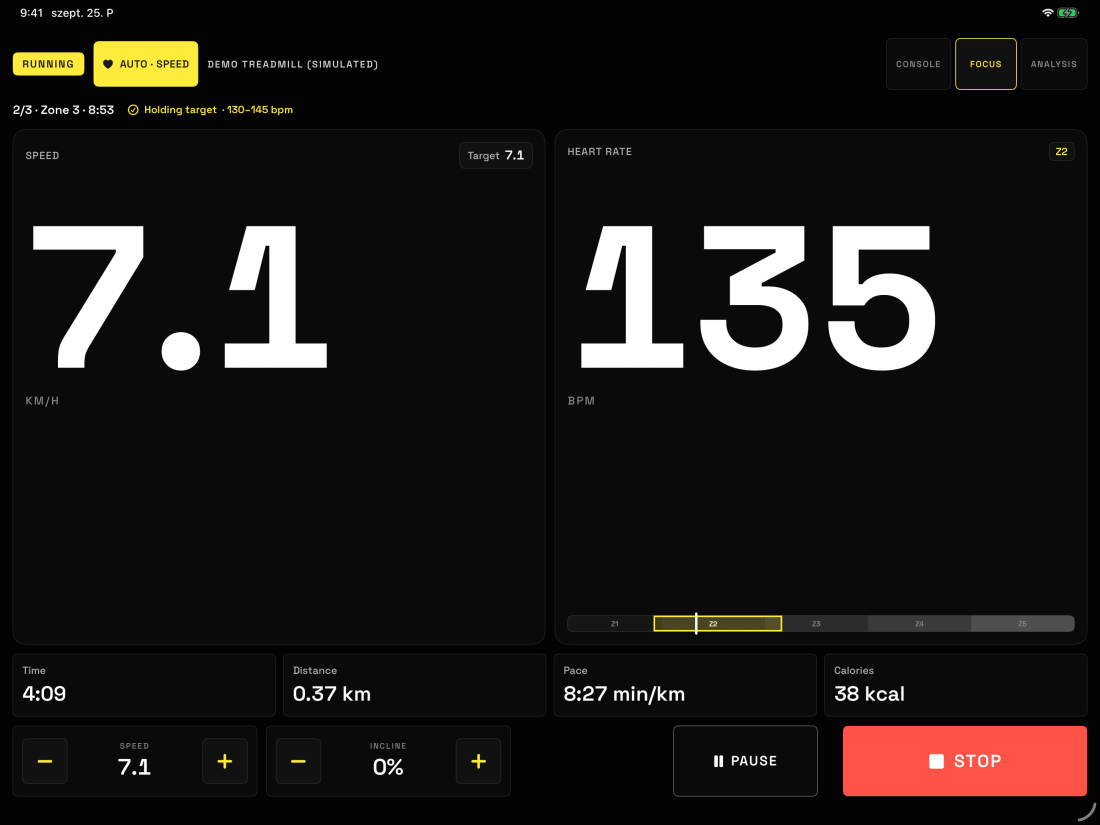
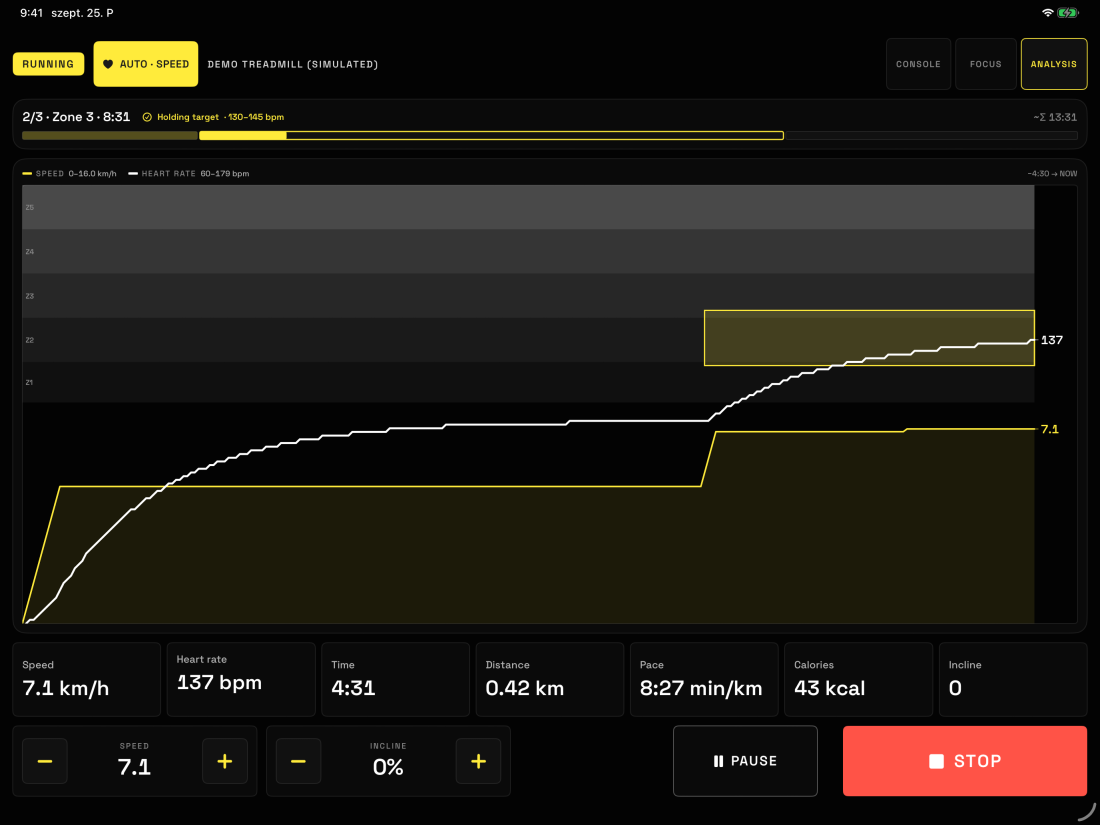
TreadPilot is one universal app: the same build runs on the iPhone in your pocket, and in landscape on an iPad it becomes a full control desk — the whole program laid out left to right, numbers you can read mid-stride, and a stop button that never moves.


Captured on an iPad Pro 13-inch simulator in landscape, in the app's Demo Mode on a simulated treadmill — so the numbers are simulated rather than a real run. The segment running in all three is holding a heart-rate zone, which is why the target band is drawn on the gauge and on the chart.
Pair any standard Bluetooth chest strap straight to the iPad. Or, if you already run with an Apple Watch, switch the heart-rate bridge on in the iPhone app and the Watch arrives at the iPad as exactly that kind of sensor. A reading that has gone stale is never handed on as a live one.
Use the phone for a compact running view, or put the iPad on the console shelf for more space. Both use the same workout programs and require iOS or iPadOS 17 or later.
Explicit confirmation before the belt ever moves, a countdown you can cancel on a programmed start, and the same governed limits on heart-rate segments that The Lab writes about. A bigger screen gets no more authority over the machine.
From the first connection to a saved workout. Explore the everyday screens, alongside the Coach that plans your next run. Captured in Demo Mode with sample data.

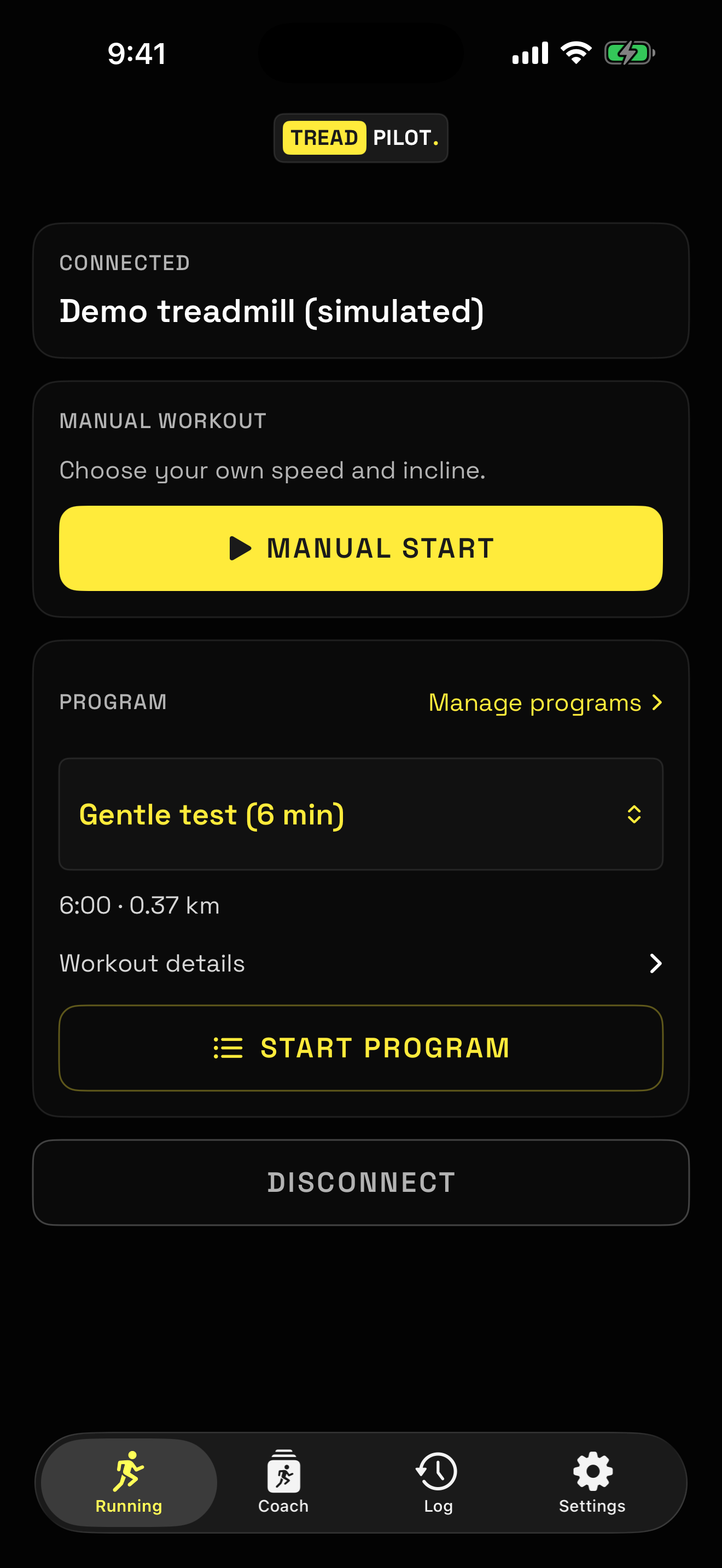
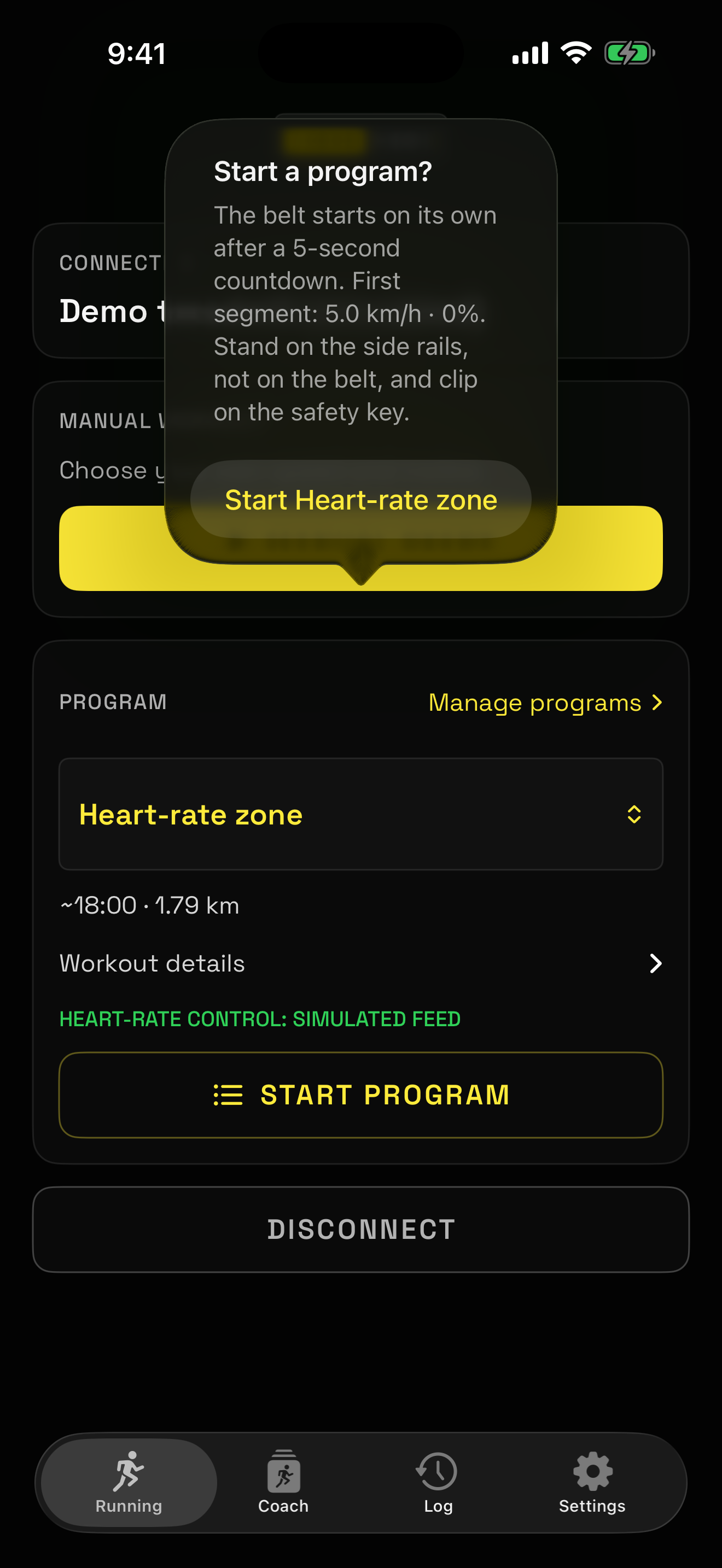
Switch the console on, open TreadPilot and select your treadmill from the Bluetooth scan. Then choose a manual run or a program.
No treadmill yet? Demo mode runs the whole app on a simulated belt.

Your current block, speed, pulse and progress together. Clear numbers while you run, with pause and stop always within reach.
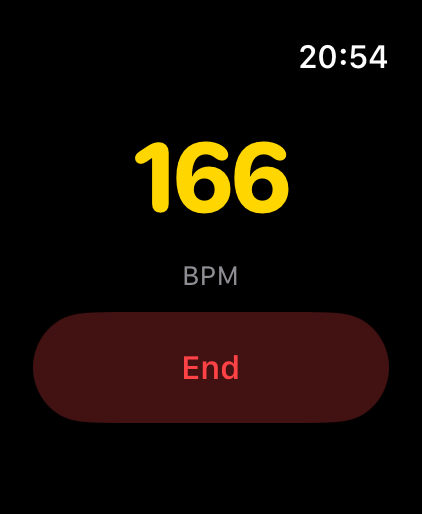
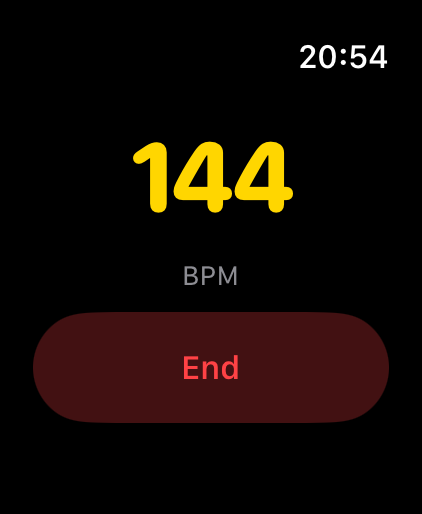
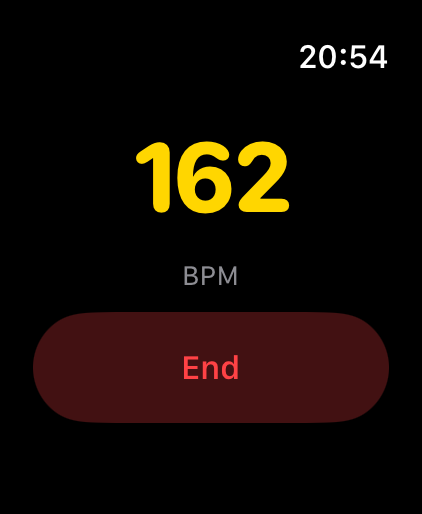
Wearing an Apple Watch? Your heart rate appears here on its own.

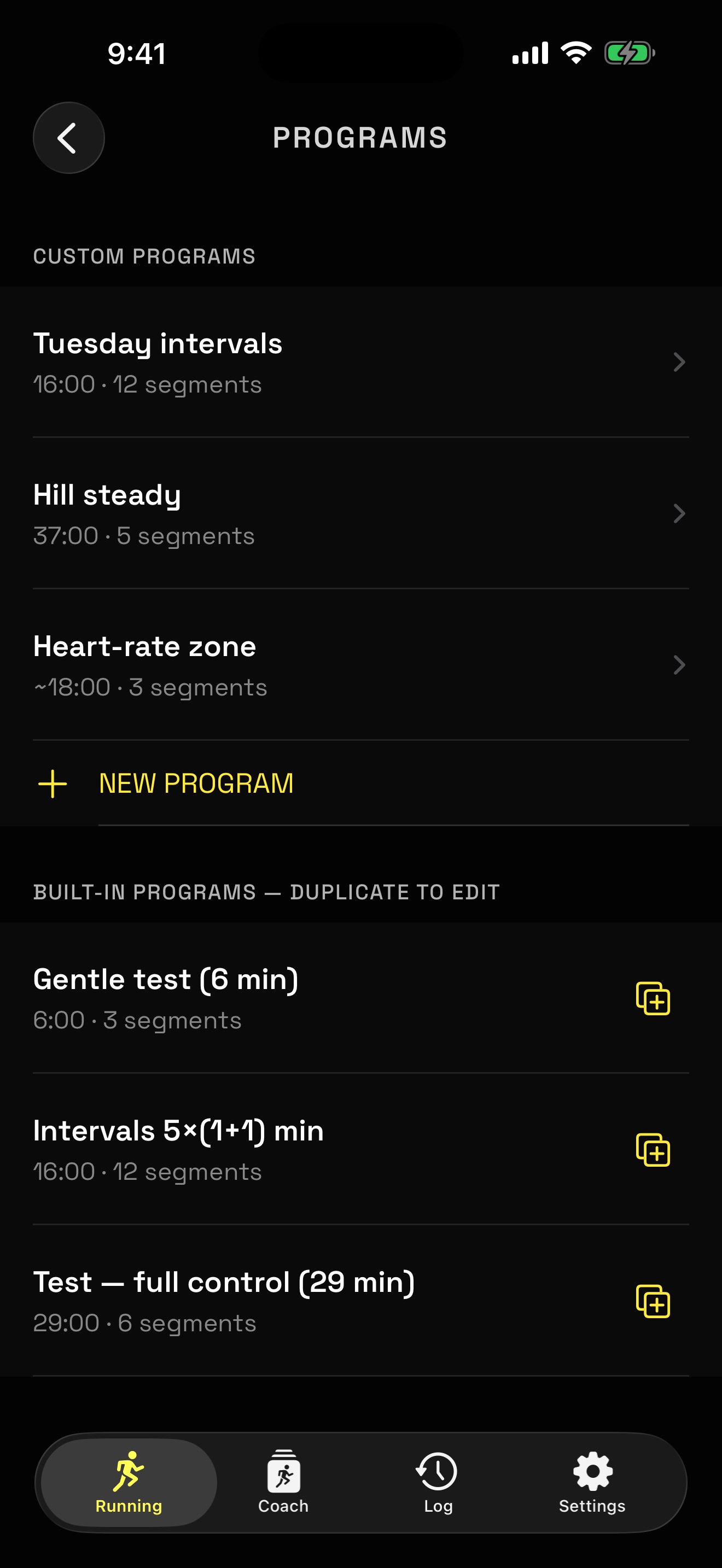
Keep your own programs together, with built-in sessions to use as a starting point. Duplicate any built-in to make it yours — the originals stay untouched.

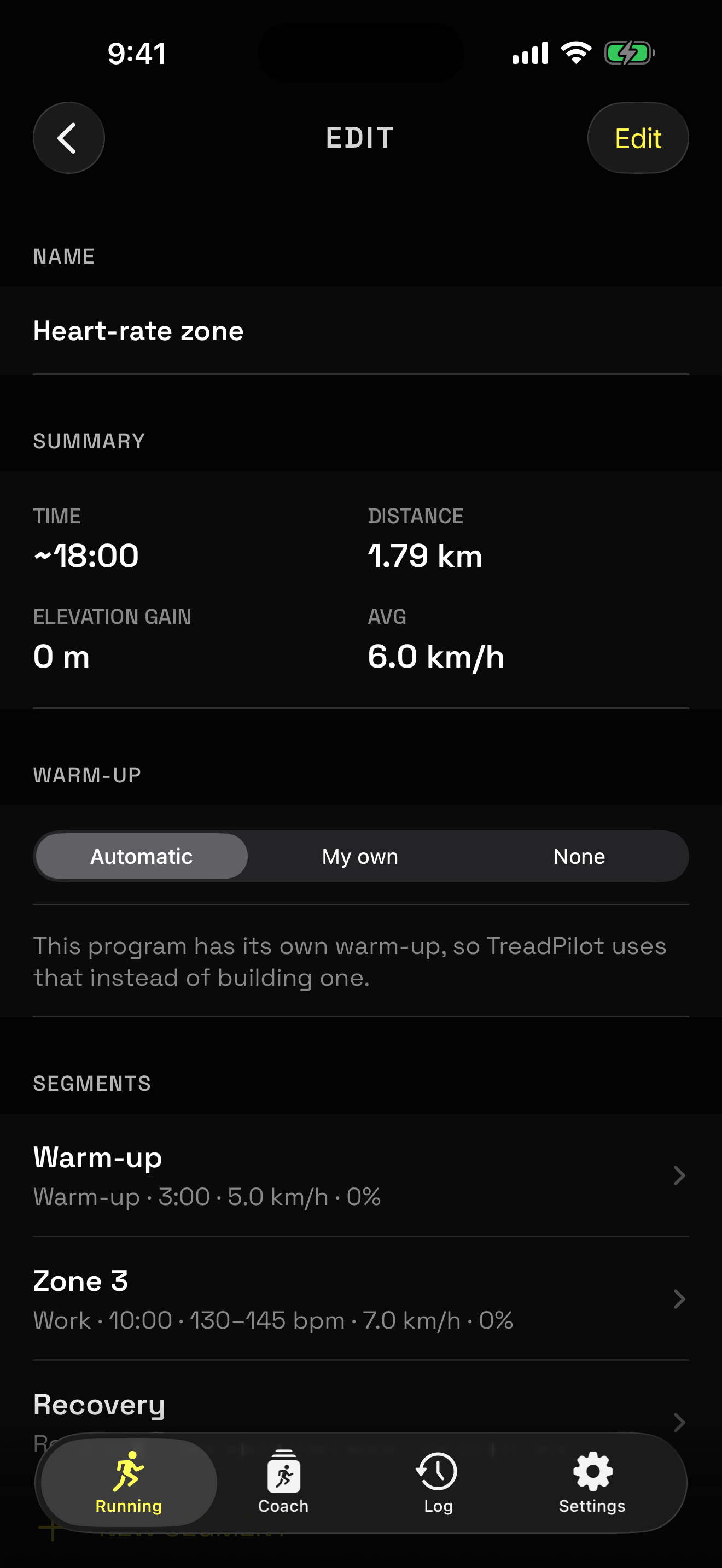
Add segments and choose what ends each one — a time or a distance — set a target speed and incline, or let the segment hold a heart-rate zone instead. The summary recalculates as you type — total time, distance, elevation gain and average speed, before you ever step on.
Heart-rate segments are opt-in, off by default, and need a live Apple Watch or standard Bluetooth sensor feed.

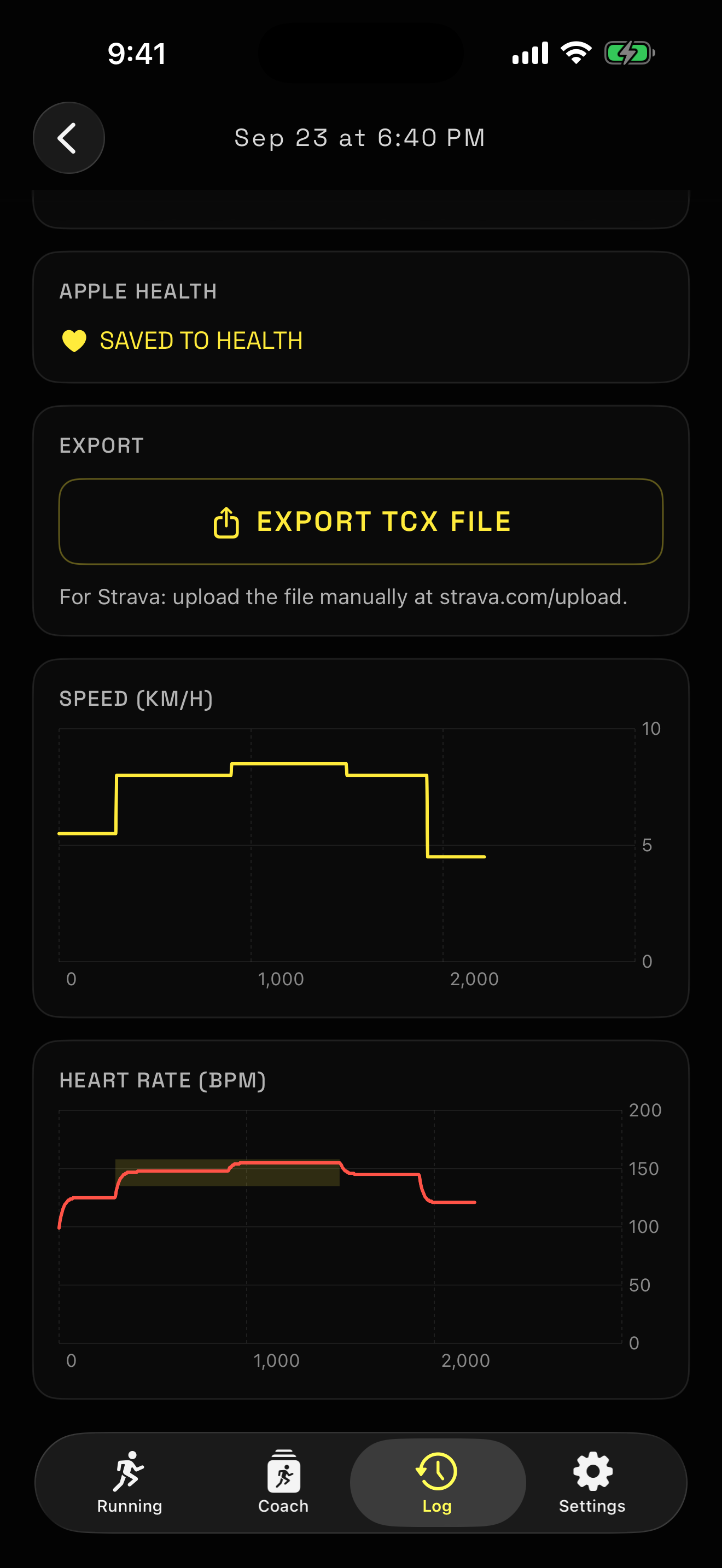
When the belt stops you get a summary. With your permission, completed workouts can be saved to Apple Health automatically or with one tap.
Missed a sync? Open the workout later and save it from here.

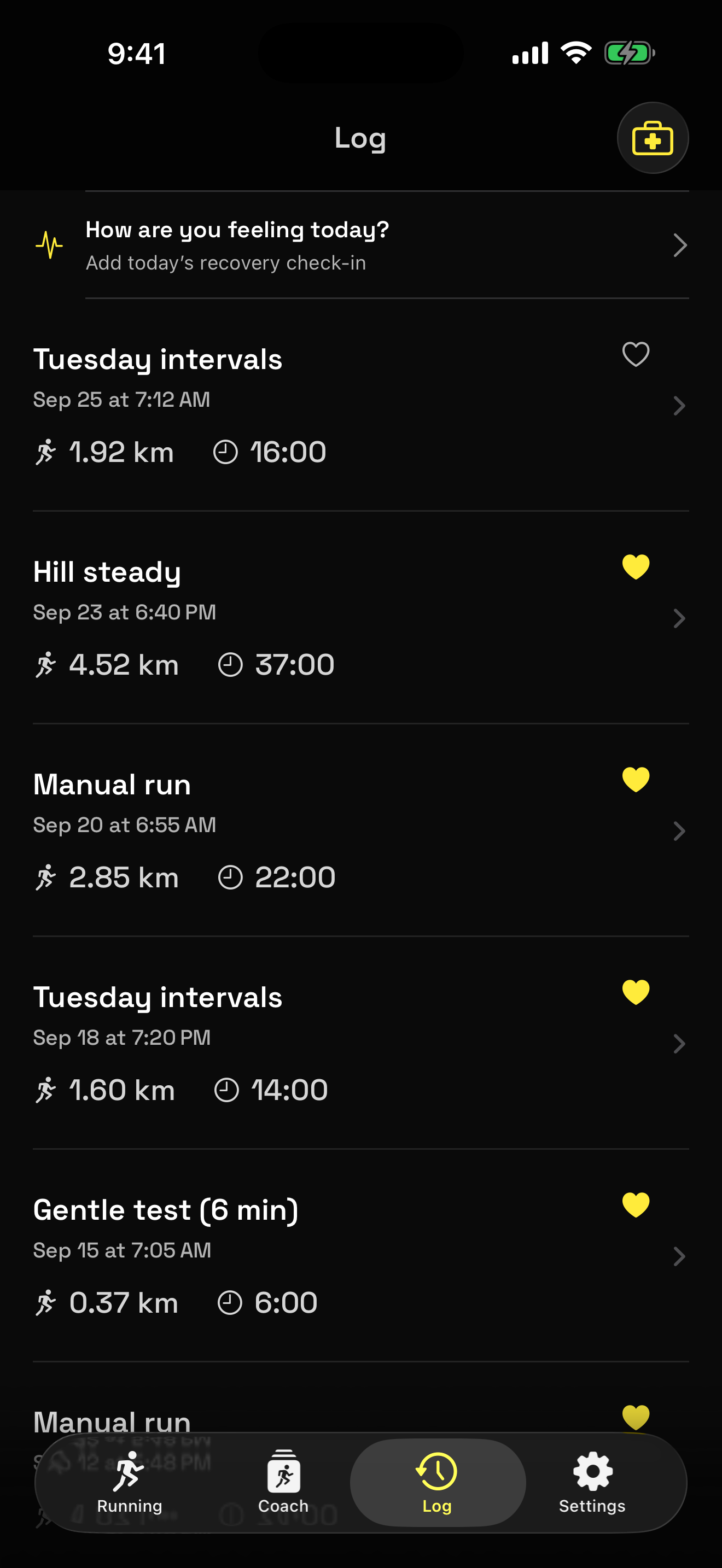
Review saved sessions with speed and heart-rate charts, plus the status of each workout’s Apple Health export.
Your history stays on your devices, with optional sync through your own iCloud account.
TreadPilot is being prepared for its App Store release on iPhone and iPad, with an Apple Watch companion. Until then, explore the features, view the app preview, and see how structured treadmill workouts work from connection to Apple Health.
# TreadPilot STATUS COMING SOON DESTINATION APP STORE IPHONE iOS 17+ IPAD iPadOS 17+ WATCH watchOS 10+ TREADMILL FITSHOW BLUETOOTH WORKOUTS APPLE HEALTH
Every behaviour decision in TreadPilot is backed by research — published science, what commercial treadmills actually do, and simulations calibrated against real workout logs. The Lab is where we write it up, in plain language, charts included.
Your history, a measured profile, a goal and a real calendar. How the new Coach turns them into varied training weeks, controls the treadmill, and learns without mistaking one tired evening for lost fitness. The calculations and engineering inside.
Read it → TP-216 · Heart-rate controlA dropped Watch signal sent one real workout to a 3.0 km/h crawl, and the controller took 20 minutes to reach the 130–145 zone. The log shows why, and three planned changes cut that to about six minutes in simulation — with zero overshoots in 210 stress runs.
Read it →Numbers from real workouts are labelled as measured; numbers from our calibrated simulations are labelled as simulated. When a fact-check corrects us, the corrected number is the one you read.